Middleware and integration hub

One place for webhooks in, transforms and calls out

Receive webhooks, transform payloads, route with decision tables, call REST, OData and SQL systems with retries and error workflows, export every event to Splunk, Datadog or OpenTelemetry, and promote config across environments as code.

The problem

Point-to-point integrations multiply quietly.

Each new partner or SaaS tool gets its own script, function or cron job. Credentials end up in several places, failures are found by customers, and nobody can say which version is running in production.

  • Glue code spread across functions, scripts and schedulers
  • Silent failures and hand-written retry logic
  • Dev, test and prod drifting apart

How UserTasks solves it

A governed hub that is still just code and config.

Webhook and Middleware triggers receive events; expressions, JSON and collection nodes reshape them; decision tables route them; references call your APIs and databases with centrally stored credentials. Failures retry with backoff or go to an error workflow, and every call is an event you can export.

  • Webhook trigger (queue and answer) or Middleware trigger (answer with the result)
  • 70+ expression functions, JSON, CSV and Excel nodes for transforms
  • REST, OData and SQL references with encrypted credentials and OAuth
  • Export, diff and apply config between environments, or sync with GitHub

Architecture

How the pieces fit

Middleware and integration hub architecturePartner webhooks, SaaS events and files arrive through webhook and middleware triggers. UserTasks transforms the payload with expressions and JSON nodes, routes it with a decision table, and retries or runs an error workflow on failure. It calls REST and OData APIs and databases, and exports every event to Splunk, Datadog or OpenTelemetry.EVENTS INPartner webhooksSigned, per-hook secretSaaS eventsWebhook triggerFilesCSV · Excel · JSONCALLS OUTREST and OData APIsReferences · OAuthDatabasesPostgres · SQL Server · moreLog platformSplunk · Datadog · OTelUserTasks engineWebhook / Middleware triggerTransform: expressions + JSONDecision table routingRetries and error workflows
Partner webhooks, SaaS events and files arrive through webhook and middleware triggers. UserTasks transforms the payload with expressions and JSON nodes, routes it with a decision table, and retries or runs an error workflow on failure. It calls REST and OData APIs and databases, and exports every event to Splunk, Datadog or OpenTelemetry.

In practice

Wire a webhook and promote it

Create the inbound hook, send it a payload, and move the whole configuration from dev to prod after review.

shell
usertasks webhooks create <workflow-id> --set slug=order-intake
curl -X POST "$USERTASKS_URL/api/webhooks/inbound?hook=order-intake" \
  -H "Authorization: Bearer <secret>" -H "Content-Type: application/json" -d @order.json

usertasks --profile dev config export ./config
usertasks --profile prod config diff ./config --exit-code
usertasks --profile prod config apply ./config
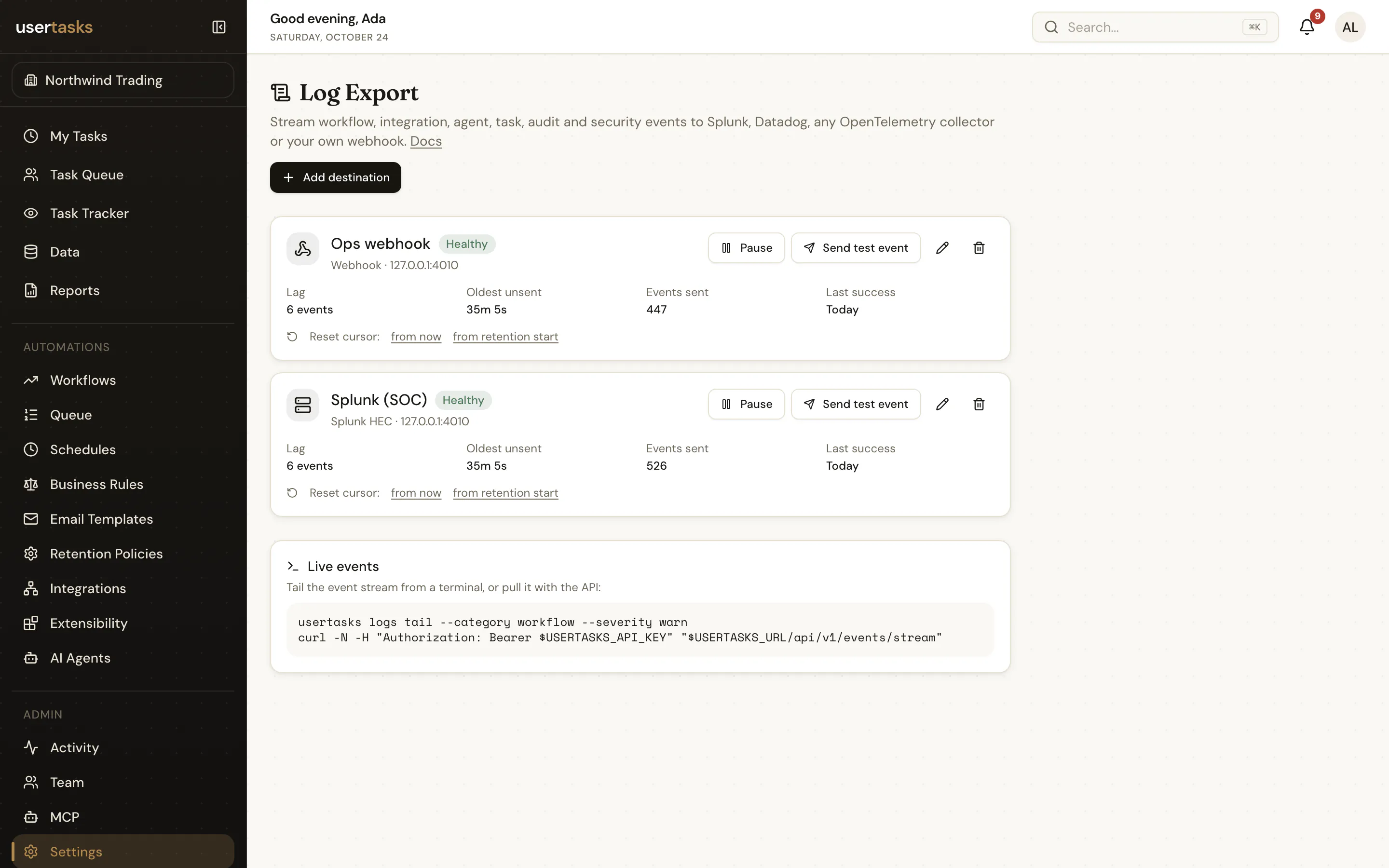
The UserTasks log export settings listing a Splunk HEC destination and a webhook destination with healthy status
Log export: every run, call and change shipped to Splunk, Datadog, OpenTelemetry or a webhook.

Frequently asked questions

Can a workflow answer the webhook caller synchronously?

Yes. A Middleware trigger keeps the request open until the run finishes and returns the run’s variables, so a workflow can validate or enrich a request in line. A Webhook trigger answers as soon as the run is queued.

What happens when a downstream system is down?

Queue jobs retry automatically with backoff before they are marked dead. Per node you choose whether an error stops the run or continues with the error in variables, and a Workflow Error trigger can run a central error workflow.

Which databases can references query?

Postgres, SQL Server and MySQL work out of the box; Snowflake, Oracle and MongoDB are available through optional drivers on self-hosted installs.

How do I keep dev and prod in step?

Use config as code: export a workspace to files, review the change, diff it against production and apply it. Secrets stay out of Git. GitHub sync can commit every change and deploy pinned commits.

Related use cases

Build it on an engine you control.

Open source under Apache-2.0. Use the cloud, or self-host it next to your own systems.